I said in my last post that I would write a series to tackle the links between gardening/landscaping practices and planetary boundaries, with recommendations on how to shift your practices. This is the first such post, with recommendations specifically related to gardening-related CO2 emissions and climate change. (CO2 is just one greenhouse gas, and others will be addressed in future posts about future practices.)
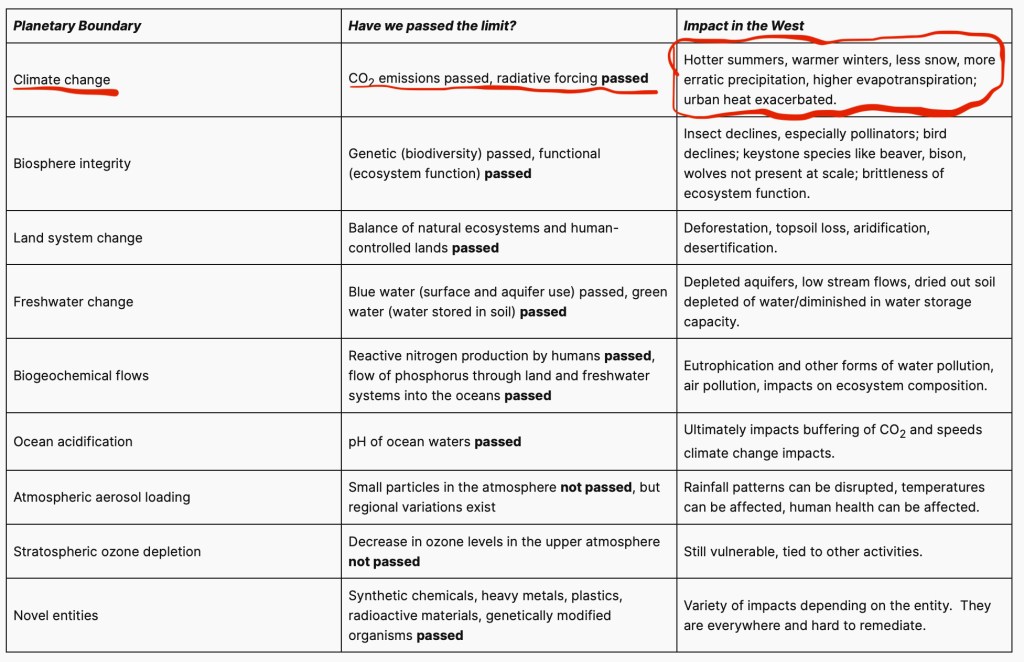
The Stockholm Resilience Centre attributes the cause of CO2 emissions and climate change to burning of fossil fuels and other sources of greenhouse gas emissions and “aerosols from sources such as agriculture, and changes in albedo (the reflectivity of the Earth’s surface) resulting from land-use changes and natural ecosystem degradation.” In a nutshell: burning oil, coal, natural gas etc. releases long-stored carbon in the form of carbon dioxide, (and to a lesser extent nitrous oxides and methane; these are also greenhouse gases) to the atmosphere where they trap heat. Aerosols are tiny bits of solid or liquid material suspended in the atmosphere which interact with heat trapping or blocking and have other impacts. They come from burning materials (like fossil fuels and forests), from volcanos, from airborne dust and soil, and more. As we degrade land, stored carbon can be released, disturbed soil can be lost through erosion, and greenhouse gases may be emitted.
The impacts we feel in the American West include hotter summers, warmer winters, less snow, more erratic precipitation, more erratic temperatures, higher evapotranspiration, more floods, more drought; exacerbation of urban heat. As I write this post, we’re in the middle of I can’t remember which heat wave this summer, starting the 11th month of a drought. We had dramatically little snow last winter. The precipitation we have received this year has come bunched into a few time periods. All of this is more likely because of climate change.
Soil is thinner than most people realize (a few meters to tens of meters) and covers a relatively small proportion of the earth’s surface. If Earth were the size of an apple, the depth of soil on Earth would be waaaaaaaay thinner proportionately than that thin skin of the apple. Most of the apple (around 3/4) would be ocean. Of the 1/4 which is not ocean, much is rock (mountains) or desert. Despite its relative scarcity, we rely on soil directly (eating plant crops) or indirectly (by eating animals which eat plants) for the majority of our food and a lot of other resources, like fibers, wood, and so on.
Soil also serves as a remarkably powerful reservoir of carbon on the planet: it holds around three times the amount of carbon found in all animals and plants on Earth and three times the amount held in the atmosphere. (CITE) The biggest reservoir of carbon on Earth is the deep ocean; soil is the second largest and way more accessible and cycling more rapidly. Carbon in soil is mostly in the form of soil organic matter, and to a huge extent, it is what enables plant life, agriculture, fresh water, and biodiversity. It helps hold water in soil and increase drainage (crazily, these two things are not at odds with each other). It helps hold and cycle nutrients for plants. It helps bind pollutants in soil and make them less accessible to living things. CITES
Where I live, it’s high and dry, with cold winters. We have low soil organic matter, and in cities and developed areas, there is generally even less; it has been diminished because of development (bulldozing, moving and removing original soil, digging for foundations, etc) and mainstream gardening practices CITE (rockscapes, landscape fabrics, over-reliance on tilling and disturbance, compaction). I do everything I can to nudge the carbon in my soil upward, knowing that it takes years of consistent small practices to make an impact and restore soil health and increase soil organic matter and soil health. No matter what anyone tells you, YES, you can improve this, and NO, you can’t do it all at once.
Fun motivating facts:
- An increase of 1% OM/acre holds 22,000 gallons more water
- A 1% increase in OM is 11,600 pounds of C per acre
Research found that just leaving the leaves and using a mulching mower instead of removing grass clippings can increase soil organic matter by 0.7% over 20 years. That’s from essentially NOT doing things! What if you are “doing something” more systemically?
| What I do | The impact |
| Plant densely | The soil is full of roots. Root turnover deposits carbon (soil organic matter) in the soil. Roots also pump exudates, high in carbon, into the soil, which helps foster other soil life and soil health. Planting native plants, which in my area have deep deep roots, puts more carbon from the atmosphere into the soil. |
| Leave the leaves (and add leaves from elsewhere, including in the form of leaf mold). | Leaves are relatively high in carbon and low in nitrogen, so they break down slowly, but much faster than wood mulch, another high carbon form of mulch. They start out light and fluffy (I absolutely do not shred them) and do a decent job of not going anaerobic and stinky in my region. They foster soil life and help retain moisture in our frequently very dry soil and help infiltrate precipitation. The carbon and other nutrients in the leaves make their way into the soil. |
| Use arborist mulch judiciously: on minor pathways in the backyard, between plants, in swales. | Arborist mulch includes the whole tree. It’s usually free, it’s local, and it usually breaks down faster than commercial mulch products, which are often transported from further away and are often bagged in plastic. Excellent support for fungi, which transport carbon below ground, and other soil life. Mulch helps stem water loss from soil. The right amount also helps infiltrate precipitation. |
| Avoid digging or tilling except for where I am placing plants. | Digging and tilling disrupt soil structure and hurts soil fungi. Exposed soil respires carbon dioxide. Intact soil is less subject to compaction, erosion, and the loss of soil carbon. |
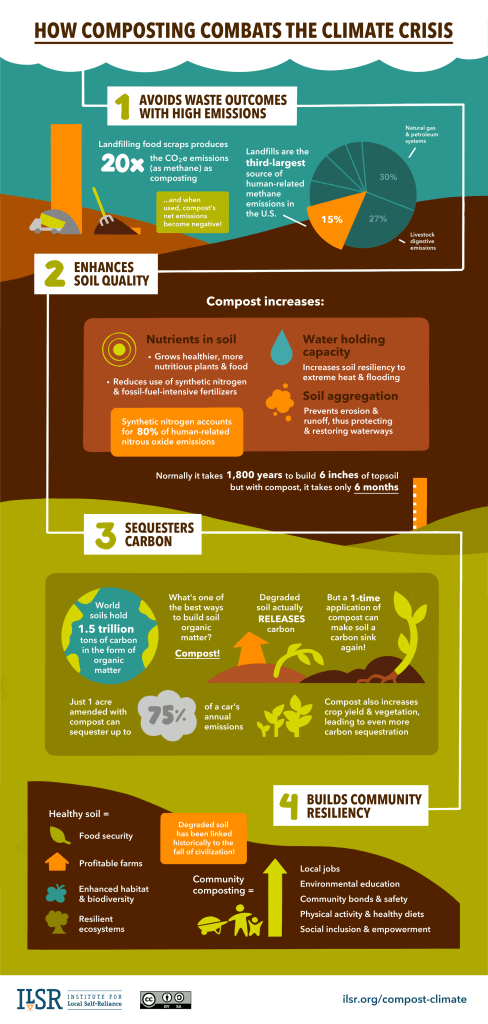
| Compost (as a verb and a noun) | I compost to be responsible for the carbonaceous wastes which come into my home. If consumption can be avoided, we do it, if it can be recycled, we do it. If it should be composted, we do it, and then we use that in propagation, in mulching new plantings, in mulching trees, etc. Top dressing with compost will eventually get the organic matter into the soil via bioturbation. |
| Biochar | Provides scaffolding for microbes, recalcitrant (doesn’t break down readily), helps with water retention, structure, nutrient availability. Another way to get carbon into the soil. We make it at home from clean waste wood. |
| Bokashi | I inoculate and ferment my kitchen waste before I add it to my hot compost. This allows me to add it at my convenience and deters raccoons and other critters, allowing me to compost while keeping wildlife safe. It adds a little more diversity to my compost. |
| Vermicomposting | I have multiple small worm bins for generating worm castings, which are a beneficial ingredient in a propagation mix and in homemade compost tea, a fun brew for getting microbes into the root zone of plants or for foliar feeding/inoculation. |
| Deep leaf mulch around most trees atop a framework of dead branches | The soil under my trees stays fluffy and moist year round, and the decaying leaves are a soft landing for insects. The leaves are an excellent way to build soil and slowly feed nutrients to my trees in a sustainable way. The branches ensure adequate oxygen for roots. |
| Keep everything as local as possible | By propagating and dividing my own plants, I eliminate transportation and fuel use. By focusing on local reuse, I get another bang out of transportation emissions. By keeping my “wastes” on site, I eliminate transportation emissions. |
| Work to avoid peat | Peat is massively used by the green industry in propagation. Peat is long-sequestered carbon and should be avoided whenever possible. I reuse potting media when I bump up plants, particularly larger plants. I am working on a peat-free germination and propagation medium using locally sourced materials. |
| Plant strategically for shade | Trees and tall shrubs provide shade but their superpower is cooling the air through evapotranspiration. By strategically, I mean that we don’t shade our solar panels and that we have good shade especially for hot summer afternoons. Shading walls and roofs which can heat up helps counter solar gain inside homes. Cooling the air makes being outside feel better. These longer lived plants also gradually accumulate and store carbon dioxide from the air in their bodies and in the soil. |
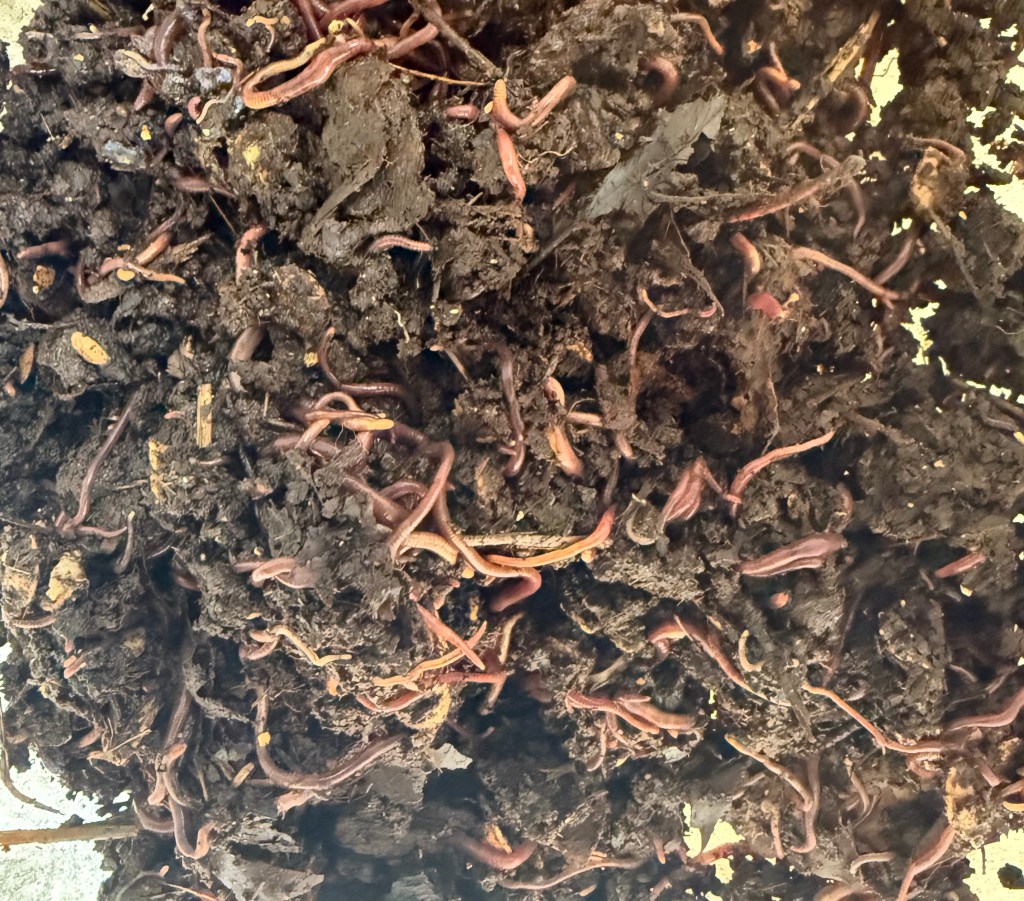
All text original, all rights reserved. Compost infographic comes from the Institute for Self Reliance; they retain those rights. The top table is drawn from text from the Stockholm Resilience Centre’s website. I urge you to visit their site and read their research. The bottom table is original. The photo is mine; all rights reserved.


Leave a Reply