This is part of a series of posts that I am writing about the Terra Foundation Grant I received in April 2024. The grant’s purpose was to replace turf in a home landscape with native plants which would support birds. The grant had a series of requirements, and I have written blog posts about how I fulfilled all of these.
“The Terra Foundation Residential Grant provides $1,000 for native plant material to install a new garden where turf has been removed in a home landscape. The Terra Foundation is committed to biodiversity and water conservation. Please see additional requirements listed in Section 2. Ten grants available.” Here’s today’s requirement:
f. Reporting at least 20 observations of plants, pollinators, and birds on community science projects. Ex: iNaturalist, Budburst Phenology Project, or eBird.
At the point of filing all of my requirements for the grant in order to be reimbursed for the plants I had purchased, I was kind of befuddled. I had have used iNaturalist, and I wanted to set up a “project” just for observations at my home, but I couldn’t figure out how to do that (I realize now that between zooming in on the iNat map and/or just selecting my own observations, I would be able to figure out what I had others had observed at home, but I digress). I couldn’t figure Budburst out… I just didn’t like the user interface, though I am interested in phenology. So I began using eBird in September of 2024.
And I haven’t stopped.
I primarily use eBird at home; I don’t think I’ve turned in any observation checklists at any other location. I will admit to being kind of a weenie beginning birder… I sit in the backyard usually, often first thing in the morning, sometimes with binoculars, often without. Usually with Merlin running, often with my phone out to try to take a shitty photo (there’s a reason I take pictures of plants and not moving creatures).
It’s the best way to start a day.
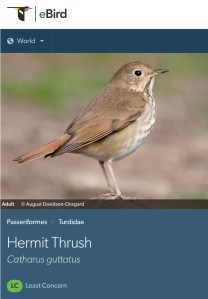
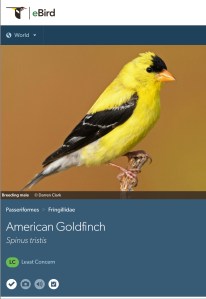
I pay attention to the weather and the sun on its way. I try to sit still so I don’t disturb bird activities. I listen so hard, and when Merlin identifies a call, I read about the bird; I am very interested in my small friends eat and what their habitat needs are, and I am trying to memorize all of the calls. I tend to relisten to all of the calls. I am a dork, because I am particularly happy when some aspect of our yard is filling habitat meeds. Hermit thrushes like dense shrubs! Waxwings like fruit! Townsend’s solitaires love junipers! Bushtits like brushy areas! Towhees like leaf litter! Goldfinches love sunflowers!
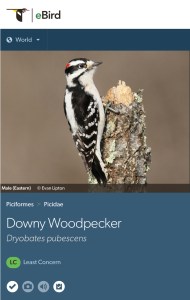
I started tracking the species that I saw or heard in or from my yard. While that has meant tons of chickadees and American robins and northern flickers and bluejays, I also count it when Sandhill cranes fly over in the fall and I hear them; Sandhill cranes are an iconic part of my ecoregion. I count great blue herons when they fly overhead (my version of a heron call: “grok grok grok”); part of my particular site is that I am relatively close to wet areas (well-wooded ditches, a creek, and a squishy area with cattails and willows). I get birds that migrate down from the mountains in winter (the Townsend’s solitaire, dark-eyed juncos,mountain chickadees) that are fewer in number further away from the foothills. I get red-wing blackbirds and very occasional western meadowlarks because of the open meadows and the squishy area to my east. Thereare a lot of mature trees in my neighborhood, so we have great horned owls, downy and hairy woodpeckers, red-breasted and90 white-breasted nuthatches, and other birds that like wooded areas. Interestingly… I do not record every time I hear one of the pair of great horned owls, but if I did, they might be in the lead for the birds I hear most often. During some times of the year, I hear them every morning (EARLY) and every evening, an sometimes in the middle of the night. (I have the sense that they are raising owlets and that it requires a great deal of coordination and communication between the parents.)
My first year, September through December, I recorded 56 species of birds in or from my yard. I had no idea that there were so many different birds hanging out or passing through. My second year, I recorded 113 species of birds. I am in my third year, and I have recorded 92 species so far this year (roughly matching the pace of species of last year), with a grand total of 130 species of birds in or from my yard since September 2024.
Spring and fall migration bring the most diverse months. When there are big storms, like hurricanes, birds can get way off course, and I catch a wanderer who is pausing to rest and refuel in my yard. Morning is the best time for observing, followed by evening before twilight. Midday apparently is a lull.
Who is here most? Off the top of my head, black-capped chickadees, house finches (with a nest right outside our bathroom window), northern flickers, blue jays (my take on their call is that they yell “BLUE! JAY!”)), American robins, American goldfinches, spotted towhees, lesser goldfinches, American crows, house sparrows, Eurasian collared-doves. Seasonally, there are a lot of hummingbirds (broad-tailed, black-chinned, calliope, and rufous), Canada geese and other migrating fowl, flycatchers, warblers, and other feathered friends that reflecting the changing weather and the changing food conditions of my yard and beyond.
So obviously, I have gone far beyond 20 observations. I’m not sure I really KNEW even 20 species of birds before I started. I’ve even been tailoring my planting additions to try to attract more birds. Clearly I could use even more members of the Helianthus genus in order to have more seed-feeding birds. Clearly I need more chokecherries and serviceberries and other fruiting shrubs and trees in order to attract and feed more frugivorous birds. Oaks yield acorns! A beaked hazelnut in the rain garden would attract nut-eating birds as well! Are twinberry honeysuckle and more currants double dips, for hummingbirds and fruit-eating birds? Can I choose penstemons tobloom rfromefresh May through September in my provide continuous fodder for hummingbirds? Do I want a prostrate Juniperus communis for Townsend’s solitaires? When our giant non-native spruce eventually passes, will we leave it as a snag to be a bird condominium complex?
I have started putting out bird feeders in the winter, after the bears have denned (and I bring them in before they emerge in the spring). While my yard provides plenty during the growing season and I don’t want to attract bears or worse, winter is a harder season. I refresh water in my birdbaths year round, and this may be the year that I finally get a heater for one to keep it ice free.
Earlier this year, I joined the Cornell Lab of Ornithology’s Garden for Birds project. Now when I am doing my almost daily checklist, I can indicate that the birds should be included in that project. To find out more about this community science project, visit their website. https://www.gardenforbirds.org
Today’s post really functions as a love letter to birds.
All images are screenshots from eBird, property of the Cornell Lab of Ornithology. I really want you to try and use eBird, Merlin, and Garden for Birds.


Leave a Reply