Reminder: I’m doing a series of posts over two months or so on the Terra Foundation Grant I received in April of this year. “The Terra Foundation Residential Grant provides $1,000 for native plant material to install a new garden where turf has been removed in a home landscape. The Terra Foundation is committed to biodiversity and water conservation.” The grant had extra requirements in six categories, and I am devoting at least one blog post to each of those. In addition, I plan to do some reflecting on the whole process and what I have planned next for my garden.
This post’s theme: Including a diversity of native species and growth forms to support biodiversity. I realize that this post simply needs to break down what all of those words mean, and by doing so, I will reveal how I selected plant species to use in my habitat plantings. I’m going to focus on the HOW and the resources in this post, and I’ll do a second post sharing what I chose to add to my habitat garden.
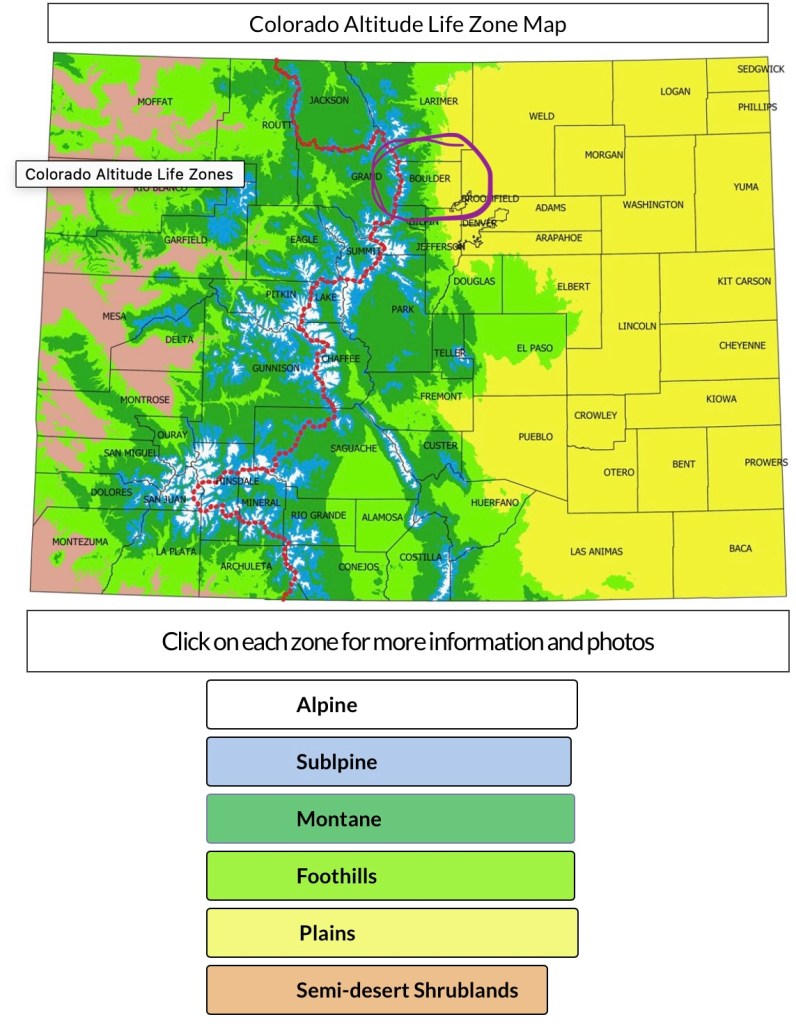
Native species (of plants): I live in Colorado. Colorado looks like a potholder thrown over a patch of North America. We have a continental divide running through the middle of the state, with surface water on the western side flowing into the Pacific Ocean, and water on the eastern side flowing into the Gulf of Mexico (and eventually the Atlantic Ocean). The Colorado Native Plant Society (of which I am an active member), describes six life zones in Colorado, mainly delineated by altitude and precipitation. I’m right at 5300′ in elevation. While I could restrict myself to only the plant species which grow in my county (Boulder), you can see from CoNPS’s Life Zone Map that Boulder County contains five life zones: plains, foothills, montane, subalpine, and alpine. I could definitely choose to plant alpine and subalpine species native to my county, growing not many miles from my home. However, these would suffer from the difference in climate (warmer and drier) in my yard. That’s not the definition of native I went with.
There are species of plants outside my Colorado “potholder” (in Nebraska, Kansas, Wyoming, New Mexico, etc.) which experience similar climates to mine in Boulder; state lines are pretty arbitrary. Urban landscapes are already impacted and degraded compared to wildlands, and in my post on irrigation, I explained that my yard has microsites with microclimates. Rather than using the outline of my county or state to tightly limit my plant choices for my yard, I have chosen to focus MAINLY on plants which are native to my life zones in my county (plains and foothills plants from Boulder County), with additions from other Colorado counties from these same life zones. I’ve added a few impactful species from these life zones (plains and foothills) in my region (outside the potholder shape of Colorado), with some mostly Colorado choices from the semi-desert region of the southwest, as dictated by conditions in microsites. Let me explain this complicated interpretation of “native.”

The National Wildlife Federation (I’m also a member of this great organization) supports the growing of native plants to support wildlife. They have created resources which list the Keystone Plants for an Ecoregion. “Ecoregions are areas where ecosystems (and the type, quality, and quantity of environmental resources) are generally similar.” Using the research of entomologist Dr. Douglas Tallamy and horticulturist Jarrod Fowler, the species of plants which support the most native bees (Fowler) and caterpillars of butterflies and moths (Tallamy) were determined. These, in turn, provide ecosystem services in the form of pollination and supporting food webs (including feeding the young of songbirds and countless other insectivorous wildlife). I have used these guides to select the most impactful plant species for my area for supporting biodiversity on the whole. I am on the border of the Great Plains Ecoregion and the Northwestern Forested Mountains Ecoregion. (Also in my state is the North American Deserts Ecoregion, on the other side of the Continental Divide.) Let’s unpack one of these. (Look at the image, but try to READ it from the links further up in this paragraph.)
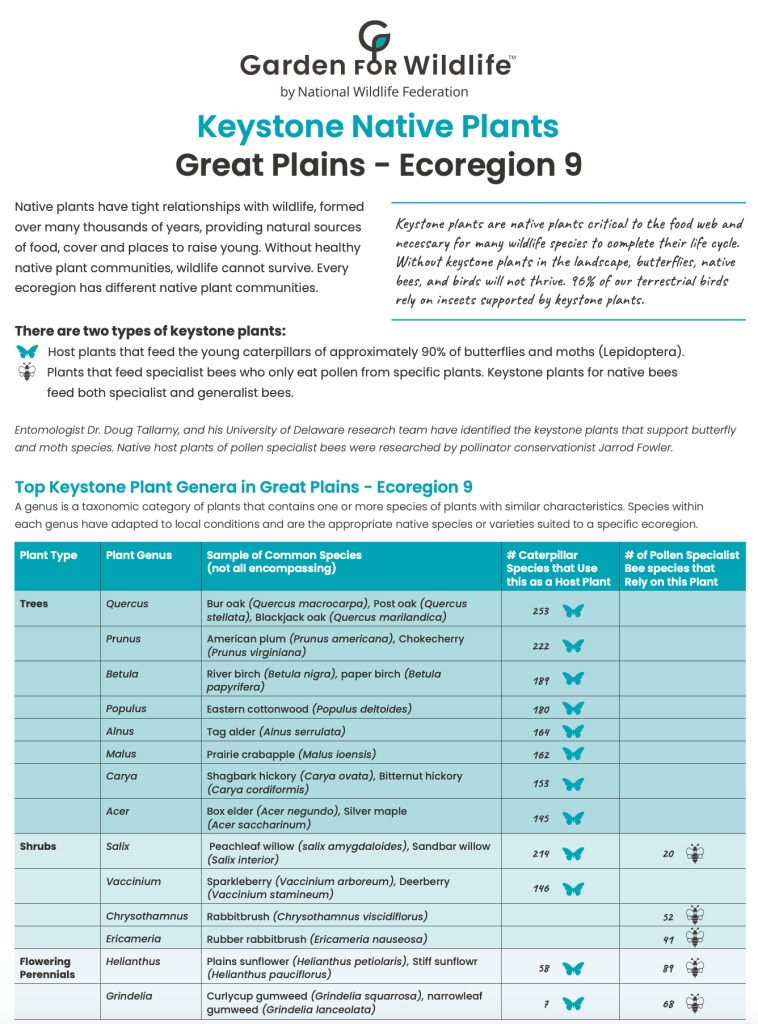
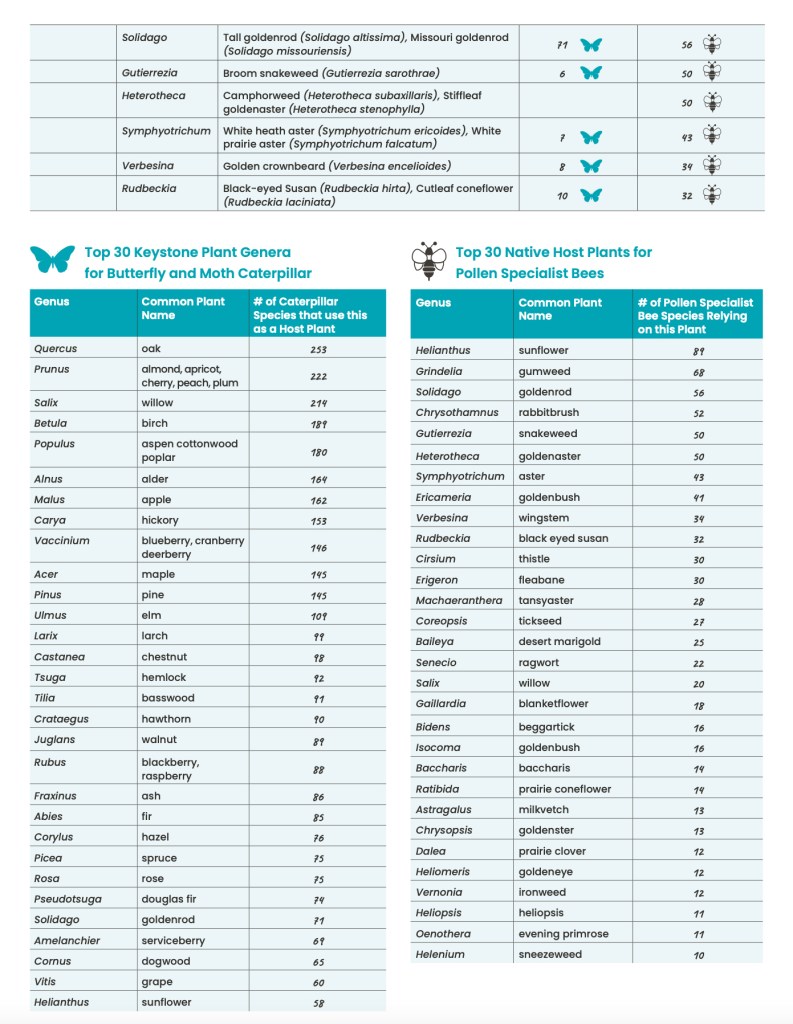
This resource lists trees, shrubs, and flowering perennials which are host plants to the highest numbers of species of Lepidoptera (moths and butterflies) and native bees. These are the species which support biodiversity. I know from reading Dr. Tallamy’s work that these plants also support many other species of insects and other arthropods; if I plant these plants in my yard, I will support the largest and most complicated food webs. They support the most insects, which support birds, amphibians, reptiles, rodents, omnivorous predatory animals, grazers, etc.
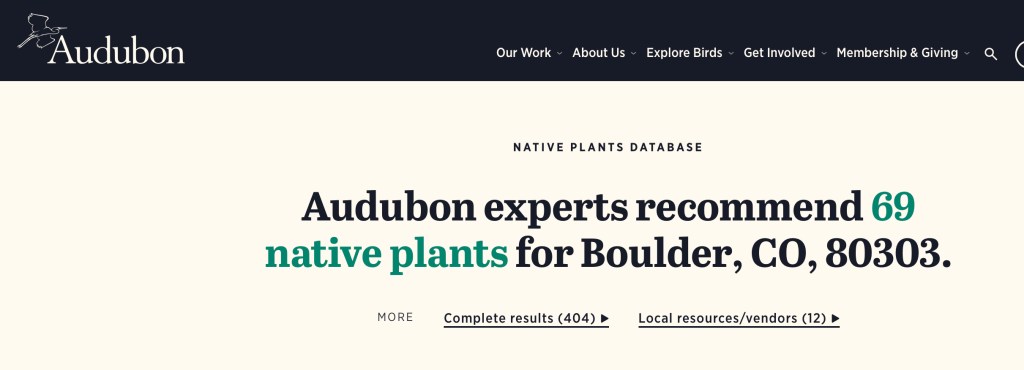
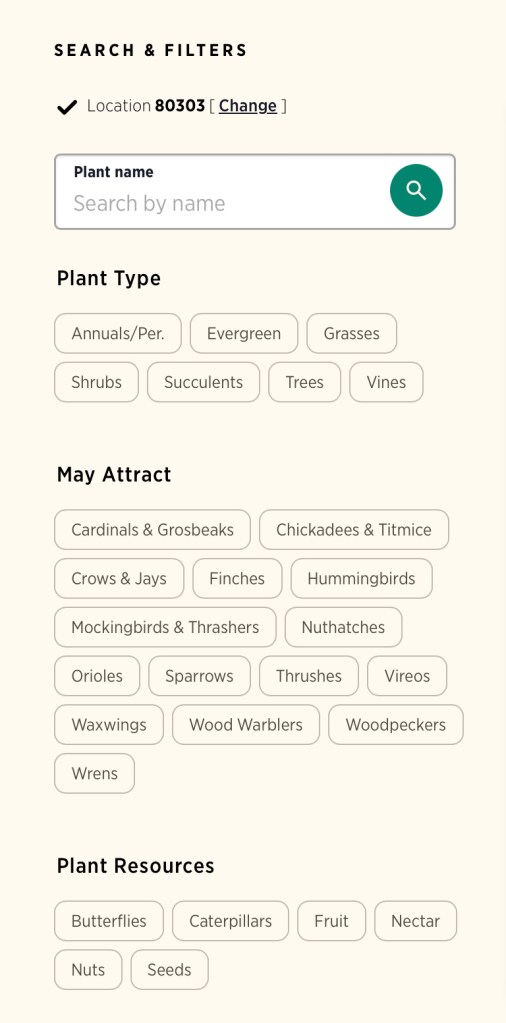
I also use the resources provided by Audubon (also a member!) to know which plants support birds. Audubon has a Habitat Hero plant finder resource to find the native plants in a specific area which best support birds. It will tell me the plants in my zip code which best support birds (coming up with a list of 69 plants). If that feels overwhelming (it does), I can use filters to search for a specific plant, choose a type of plant (say grasses or shrubs) or a group of birds I want to attract, or choose the type of plant resource the plant provides to birds. (This last category is very helpful if you are trying to certify your garden through their Habitat Hero Garden Certification program.)
There are other resources out there–Xerces (also a member!) has excellent lists of plants that support pollinators. The resources which make the most sense for me are the two plant lists for my region: Native Plants For Pollinators And Beneficial Insects: Southern Plains Region and Native Plants For Pollinators And Beneficial Insects: Rocky Mountains Region. These are such user-friendly lists, with easy to read icons helping novices to native plants figure out sun/shade, moisture, bloom time, which insects they support and how, the “form” (eg, tree or succulent) of the plant, and starred favorites by Xerces staff.
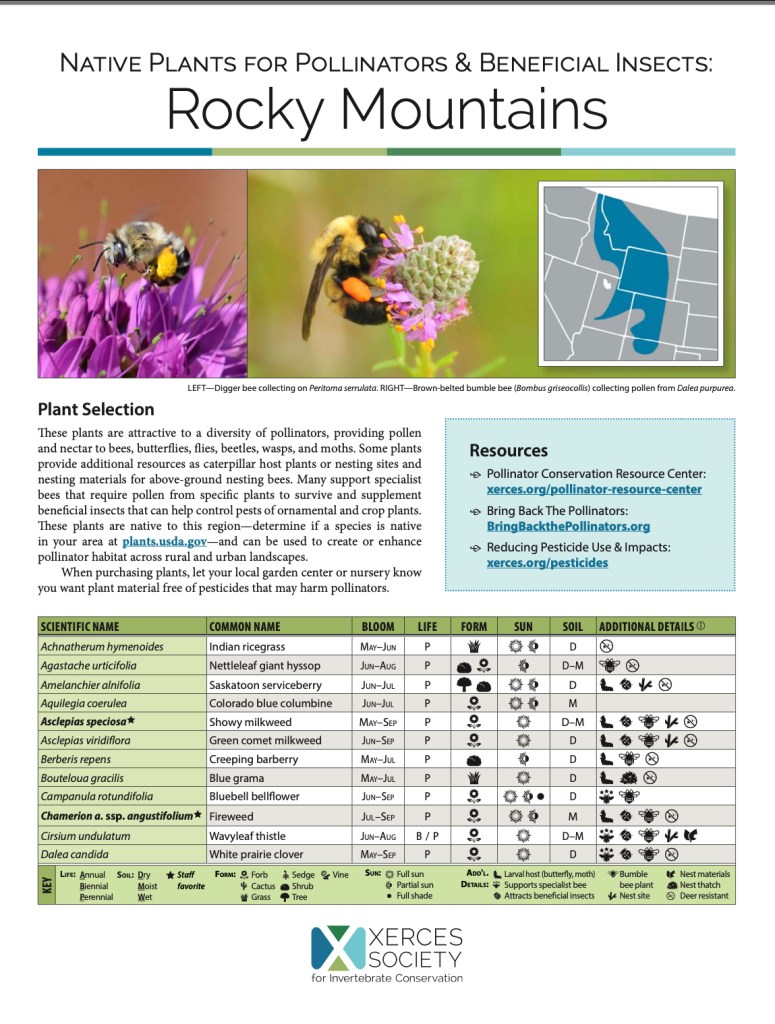
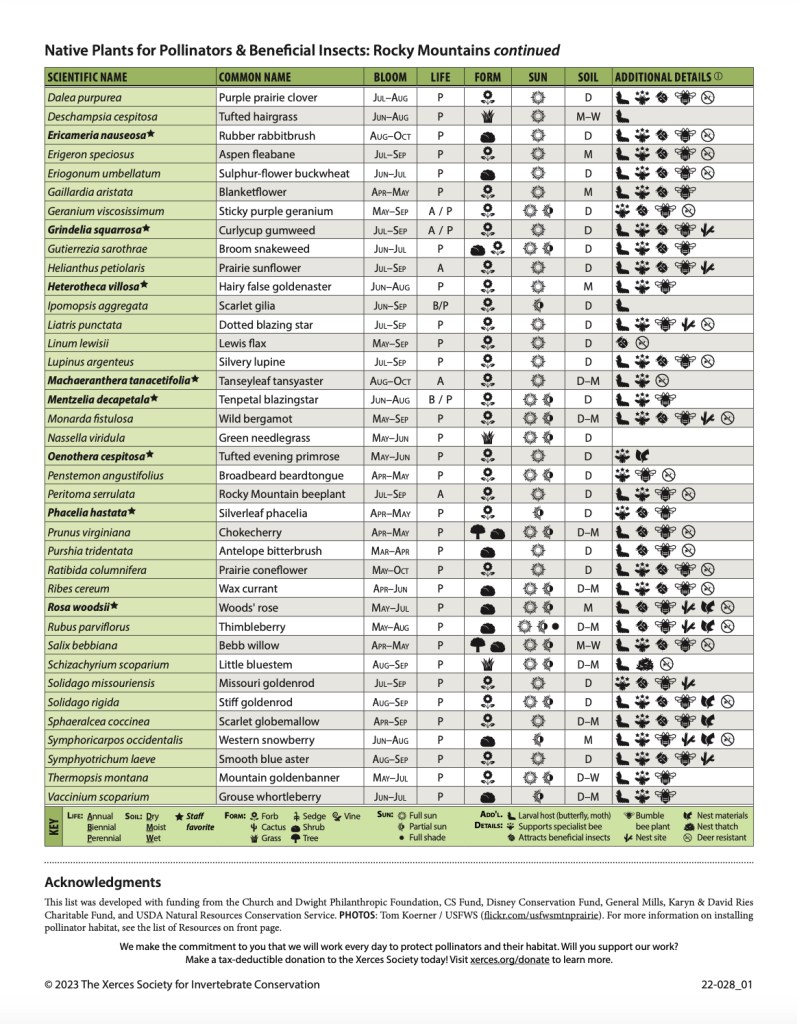
Once you start looking at these lists, repeats start popping out at you, and it becomes easier to make a master list. Which brings us to our final qualifier: growth forms. All this means is that one should include a variety of plants with different lifestyles, because those different shapes, living strategies, sizes, and seasons of activity offer up varied types of resources to other organisms throughout the seasons and in a range of sites and conditions. Growth forms include deciduous trees, evergreen trees, perennial forbs (broadleaf plants), annual or biennial forbs (broadleaf plants which live only one or two growing season), warm or cool season grasses (with resources available in different seasons), vines, succulents, shrubs and sub-trees. In addition, the season in which resources are available and the type of resources should be considered. For examples forbs are a huge group with many different forms, such as composite flowers (like purple coneflower), tube-shaped flowers (including penstemons), night-blooming flowers (examples include evening primroses), and members of the pea family (such as golden banner), all attracting unique groups of pollinators. Early spring flowers also support different pollinators compared to late fall flowers. While this is a lot to think about, the resources I’ve shared today include all of these types of growth forms and shapes of flowers.
Whew. If you click through to any of these resources, you will get a pretty good idea of what I wanted to have in my yard to include a diversity of native species and growth forms to support biodiversity. I’ll do a follow-up to this post just to chat a little bit about what I already had and what I added. (In other words… get ready for my own list.) I want to remind you that this is a work in progress. I’ve got over 100 high impact native or regionally native species of plants in my yard, and many others that I just like. But it took me time to get here, and for those which were recently planted, it will take time for them to mature, to “look good,” and to provide full ecosystem services.


 Climate Resilient Landscapes
Leave a reply to cololeslie Cancel reply