This is the third post in a series on landscaping failures and victories at home. Earlier posts covered hardscapes and beds, berms, and swales.
I’m a huge fan of landscape designer Benjamin Vogt. I encourage you to check out his website and to peruse his book Prairie Up. In a nutshell, Vogt’s aesthetic is about bringing a “scannable” or understandable prairie look to urban landscapes. He understands that the scale of the prairie is much different from that of the typical residential or business yard and that when our eyes move over a landscape, we seek to make sense of it. When we try to bring the prairie to a smaller space, we have to take measures to make it comprehensible and not seem like a jumbled mess. One of the things Vogt does with a prairie palette is to simplify it; he establishes prairie grasses or sedges on a grid, and then he plants groups of forbs in sprays and clusters within that grid. He calls this fabulous approach matrix gardening.
I myself refer to using grasses this way as using a living mulch. Mulch is something that covers soil in order to stem water loss and erosion from wind and water. If plants are close enough to each other, they can serve this purpose, and they have the added ecosystem benefits that roots in soil provide. Years pre-Vogt, I experimented myself with using grasses as a background, with forbs, shrubs, and trees planted within it.
When Vogt chooses a fibrous-rooted plant for his matrix, he selects native bunchgrasses or (generally) non-riparian sedges which are not aggressive spreaders by rhizome, and he usually uses just one or a few species. He employs either plugs or seeds, planted in the appropriate season for the species. I have learned these concepts the hard way.
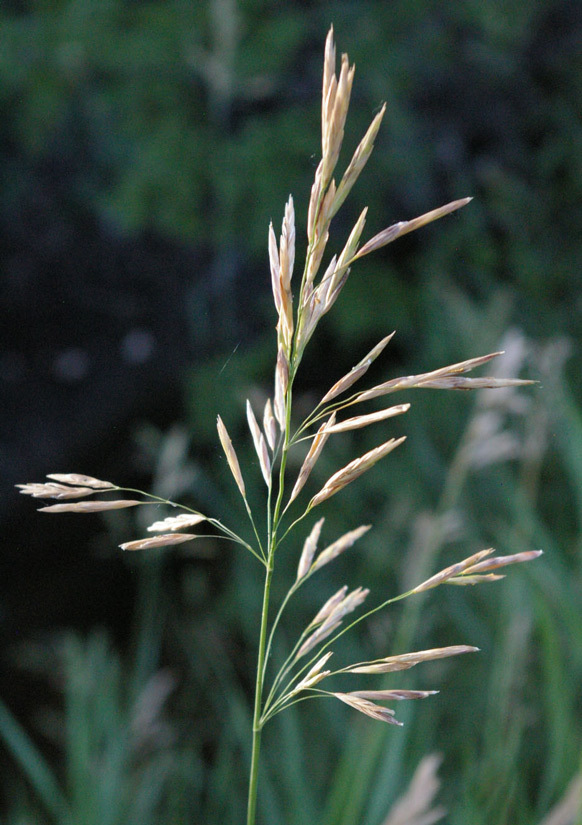
My first failures in choosing a living mulch years ago was in not knowing enough about the species in a seed mix and assuming that if the seed was sold by a Colorado company, the grasses would be native to Colorado. For sections of my yard, I chose a “dryland pasture mix” which has little to no native species. Worse yet, it was 20% smooth brome (Bromus inermus), a non-native cool-season grass which can spread aggressively by seed and by rhizome. In the areas where I used this mix, now, years later, it is 100% smooth brome. While the soil organic matter and biology has been building over the years, nothing else has happened; I have no grazing needs, and native insects and birds, my major wildlife, don’t use it. As a result, to get rid of it, in some beds, I’m having to smother it (cardboard + several inches of arborist mulch + time), in others, I’m having to hand weed it to exhaust it over time. One area on the north side of our house (which stays fairly cool and moist) will literally eat anything I try to interplant with the brome; nothing else can get established there. Worse, it’s creeping across into another area where I really don’t want it. Looking at this seed mix with fresh eyes, I’m not surprised that the dominant species took over. The rest were window dressing.
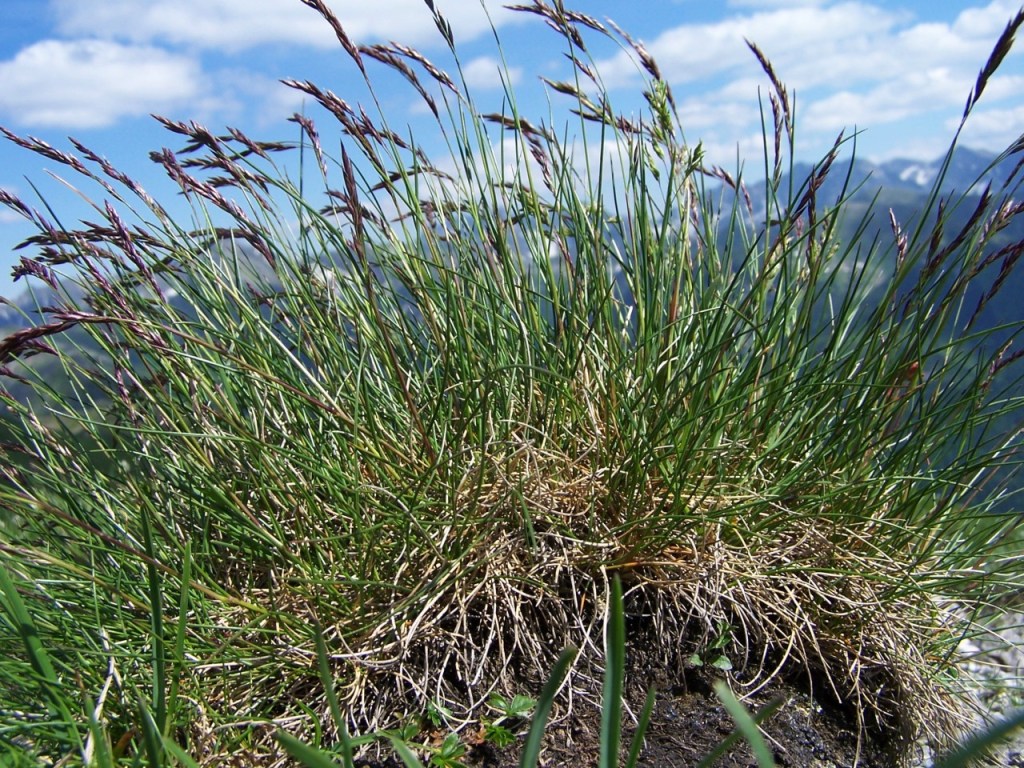
I stumbled upon a victory in another seed mix. This seed mix contained 10% Arizona fescue (Festuca arizonica), a low-growing cool-season native grass which eventually came to outcompete the other grass species in the area where it was seeded. What a great grass. It forms beautiful perennial bunches which more or less go dormant in temperature extremes and need no supplemental water or mowing. It is the host plant for several species of butterflies. It plays nicely with interplanted forbs. I intend to reuse this species alone as a living mulch. (Again, the other species in the mix were extraneous.)

Another victory came from a different experiment. We laid buffalograss (Buchloe dactyloides) sod in our front yard in the area closest to the street. The buffalograss did not thrive there on the amount of water we wanted to give it (which was little to no supplemental water after the first year). I decided to overseed it with a buffalograss/blue grama grass mixture. Fabulous! While it looks like the blue grama grass (Bouleloua gracilis) took over, it really hasn’t; the buffalograss is still there and happier with the cover the grama grass gives it. The buffalograss spreads by stolen, and the blue grama grass is a self-seeding short-rhizome bunchgrass. Both are warm-season. They very effectively shut out weeds. This area also requires no mowing.
Last fall, in the rain garden we established in the front east side yard, we planted our anchors (a few small trees and shrubs) and our clusters and sprays of forbs. We attempted to establish our chosen living mulch (blue grama grass), but I really should have known better. Seeding warm-season grasses in September is a waste of grass seed; hence, my second failure. Cool-season grasses must be seeded in spring or fall and warm-season grasses in very late spring or during summer. So watch me weeding this area until it’s warm enough to try again.
[Side note on blue grama grass: yeah, that’s the grass in my logo. I adore it. It’s the state grass of Colorado and is found in all but the highest elevation counties. It serves as the host for skippers, which I also love love love. It’s low flammability and a major component of short grass prairie.]

 Climate Resilient Landscapes
Leave a reply to Failures and Victories, Part 5: Irrigation – Climate Resilient Landscapes Cancel reply