In reflecting on my home landscape, I think about some things I am glad I’ve done as well as some choices I regret. I’ll start a little series on my thoughts. The first is hardscaping. Our victories: ribbon driveway, permeable reused paver patio, reused bench. Our failures: boulders and decomposed granite pathways.
The first thing I want to acknowledge is that yes, hardscapes have a place in landscaping. Patios, driveways, decks, pathways, sculptures, seating, and rock provide outdoor living space, allow for dedicated movement in order to minimize compaction, add visual interest, and can help with protection of infrastructure from flood and fire. However, their sourcing and environmental impact vary wildly, and it pays to consider materials and lifespan.
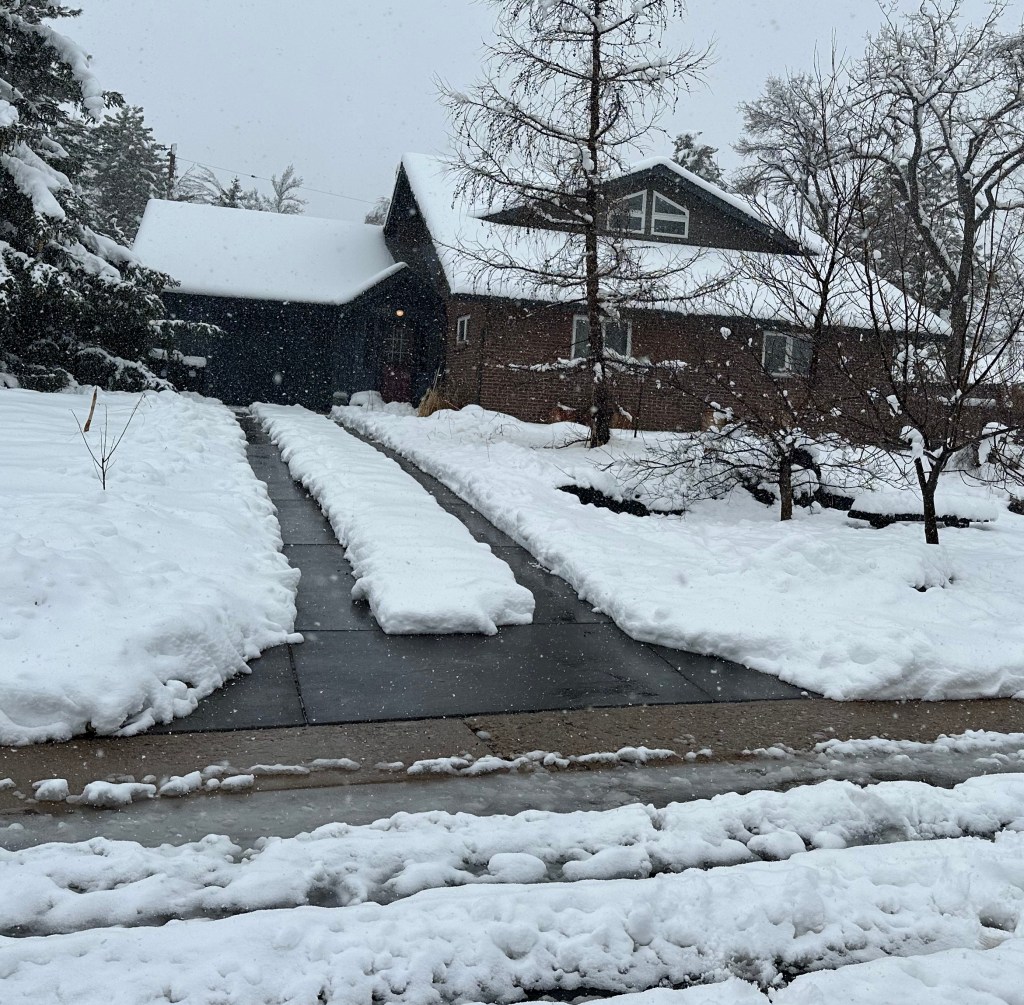
Concrete is commonly used for driveways, patios, and walkways. However, as a major source of greenhouse gases, its use should be minimized and rethought. When we replaced our crumbling asphalt driveway years ago (maintained via regular nasty applications of tar and sealcoating), we chose a concrete ribbon driveway. This style of driveway can have up to 70% less concrete than a regular driveway, and it’s a snap to shovel and requires no maintenance. Beyond the GHG emission and cost savings, it cuts the amount of impervious space dramatically compared to a typical driveway, allowing precipitation to seep directly into our soil and contributing less runoff in our flood-prone neighborhood.
When we moved in, our patio was made of pavers set in sand. We chose to reset the pavers in a new shape. Some amount of precipitation seeps into the pavers themselves, and some amount seeps between them. Ants like to tunnel between the pavers, and over time, they can become uneven. The good news is, we can fix this ourselves, and the pavers are infinitely reusable and were free. We also reused a wooden bench that was set into the old patio as a focal point in the front yard.

When we landscaped the front yard, I had wanted to use the ultimate in low embodied carbon “stone”: urbanite (used concrete chunks). However, I was vetoed by the landscaper and my spouse, because they both felt that natural rock would give a better look. I now wish I had dug more deeply and pushed harder. While natural rock can be reused and has low embodied carbon (generally from quarrying and transporting, and this rock was from Colorado), it doesn’t help sequester carbon or provide habitat for invertebrates, birds, mammals and amphibians the way alternative focal points like tree root masses, rounds of dead cottonwood, and other formerly living material can. (I have seen these used beautifully elsewhere.) Quarries and rock mines destroy landscapes. A friend has sourced used flagstone from the Resource Yard and Craigslist, and the next time I feel the need to use stone, I will follow her lead.
We used decomposed granite for pathways in the front yard. This material is natural, but it still comes as a byproduct of stone quarrying/mining. I love that these pathways are permeable and that if I want to move an element, I can rake it up and move it. However, again, they don’t help sequester carbon the way wood mulch pathways could. I have noticed that some mud dauber wasps have used a little to make brood cells for their offspring. I think some generously-spaced reused flagstone set in fine wood mulch and planted with ground cover would have been a better choice.
I have a fun addendum to this since I published this post. My son and I helped out with a tree planting project at Fairview High School. He co-designed the layout, and I have worked with the amazing student group and teacher sponsor on habitat goals and identifying grants to hopefully cover some planting of forbs later on. The planting happened yesterday (see my instagram for photos and more information about all the groups supporting this). The soil is rocky, so we brought home several sizable rocks that I will use in some beds I establish this summer. It’s pretty cool to have them—no mining was involved (unless you count student labor digging them up), and they will be a visible reminder of yesterday’s event and our kids’ time at the school. They are also from the geologic formations in the south Boulder area, so again, a visual tie to areas that we enjoy hiking.

 Climate Resilient Landscapes
Leave a reply to Failures and Victories, Part 4: Fences – Climate Resilient Landscapes Cancel reply