Reminder: I’m doing a series of posts over probably the next two months or so on the Terra Foundation Grant I received in April of this year. “The Terra Foundation Residential Grant provides $1,000 for native plant material to install a new garden where turf has been removed in a home landscape. The Terra Foundation is committed to biodiversity and water conservation.” The grant had extra requirements in six categories, and I will devote at least one blog post to each of those. In addition, I plan to do some reflecting on the whole process and what I have planned next for my garden.
This post’s theme: Removing existing non-native turf grasses from the area for your new garden. Non-native turf grasses include Kentucky bluegrass, perennial ryegrass, tall fescue, and fine fescues (creeping red, hard, chewing, and sheep). I broke this into two posts: this post gets into which methods I used and why; part one of turf removal was about methods and why turf removal helps birds.
Of all the methods listed in part 1 (solarization, smother cropping (aka cover cropping), repeated cultivation, sheet mulching, sod inversion (aka sod cutting and flipping), organic herbicide application, sod removal, synthetic herbicide application, and “stress the lawn, plant shrubs”), I have experience with cover cropping, sheet mulching, sod removal, and synthetic herbicide application (and a little “stress the lawn, plant shrubs”). For this project, I chose only solarization and sheet mulching (and a little “stress/shrubs”), and I will explain why and how it worked, but first I want to explore my previous experience with the other methods, and why I didn’t choose them for this project.
There are tradeoffs with all turf removal methods.
Smother Cropping
Smother cropping (or cover cropping) involves planting a cover crop and then tilling it in at the right time. I’ve used it in vegetable gardening when I had an entire winter and early spring for the cover crop to grow. I didn’t use it for this because my timeline was too tight: I received the grant in April, and I needed to be finished by right now. I also don’t like disturbing the soil if I don’t have to; I don’t till for native plants. Vegetable gardens also get watered more regularly than native plant gardens, which helps break down the tilled-in cover crop. Would I consider doing something like this, but maybe with a native grass blend in areas I haven’t quite gotten to yet? Maybe. In the right situation with enough time, this might be something to consider, but I would want to consider carefully which cover crop species to use.
Sod Removal
My most recent experience with sod removal was helping a friend prep a site in her own yard earlier this year. Using spades, we cut out about 100 square feet of turf by hand. This was the perfect method for this small site, and we were able to carefully work around the edge of a mature tree and avoid roots. She got instant results and was able to plant immediately. However… what hard work. My friend also had to figure out what to do with the sod pieces (I think she made a berm in her backyard).
Most sod removal involves renting a sod cutter or paying for a service. Resource Central charges either $1/sq ft for qualified applicants or $2.50/sq ft, which adds up. Resource Central’s figure includes dealing with the removed sod. Because we were dealing with a pretty big area (more than 1000 sq ft), and because a lot of the grass was in poor shape to start with, we didn’t choose this method.
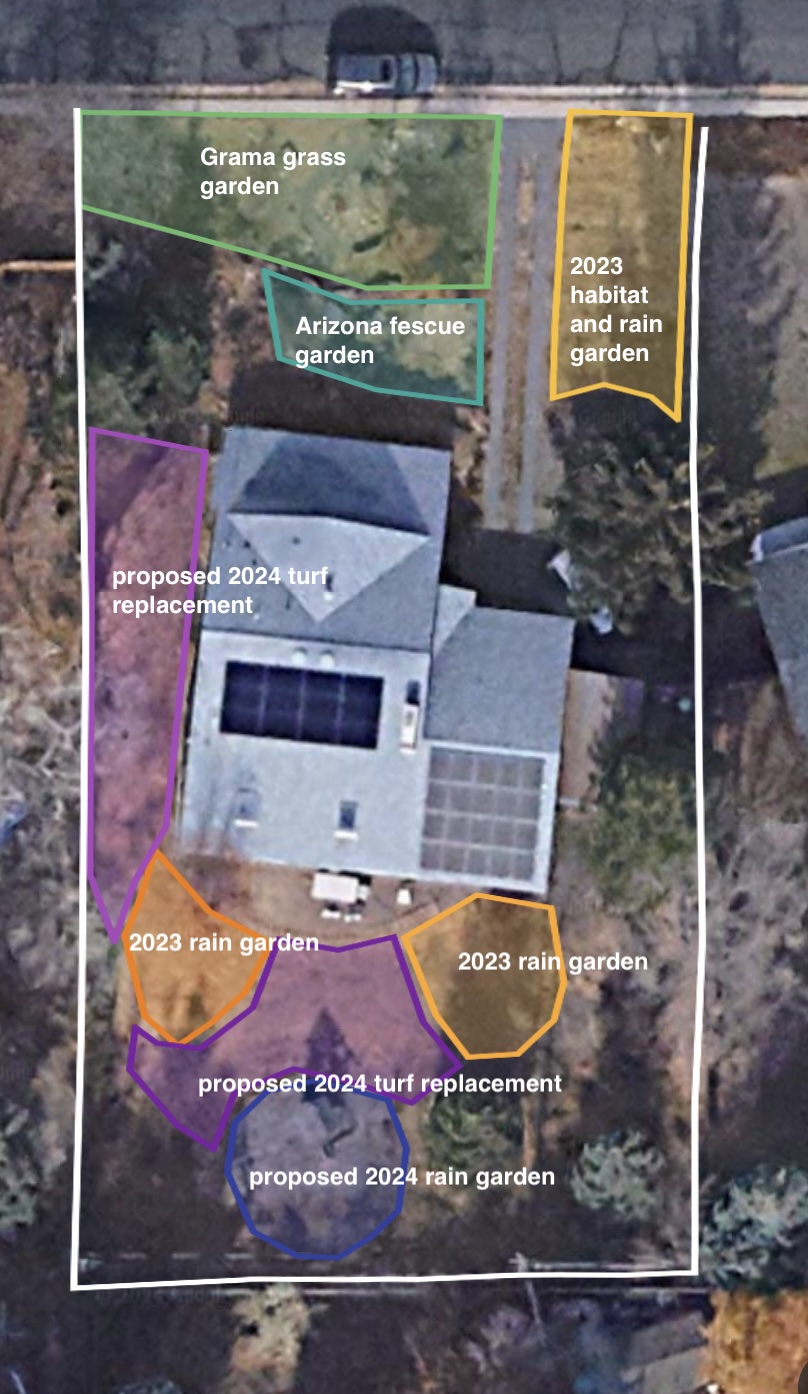
I also did sod removal to some extent when I created my 2023 rain gardens (in orange in the backyard in the schematic below). We cardboarded the areas in the backyard to kill grass, and then we excavated a bit (4-6″?) in order to create rain basins (edged by small berms and dead wood for insect habitat). It was not as tough as my friend’s turf, because the grass was dead. I also had the help of a strapping young person with the digging, otherwise, I’m not sure I would have gotten it done by myself. The soil scientist in me cringes around moving top soil, but that’s a whole other topic.
Glyphosate
I want to mention this because I know it’s out there. It absolutely was not on the table for this project, because I had existing pollinator and bird habitat in my yard, and I knew that while some people are able to spray once, install immediately, and be done with a relatively minimal impact, I wouldn’t. I knew that I would likely impact existing tiny wildlife, and I expected to be planting over a range of a few months, which would give weeds a chance to regrow and negate the point of using a pesticide. (I also believe that the Terra Foundation people would disapprove of the use of Roundup for this project, and rightly so.) When we put the lawn in 20+ years ago, the backyard was a disaster, and yes, we did spray and install immediately. Now I know better, and I’m doing better. If you can avoid this method, please do. If you can’t, I recommend that you be absolutely ready to go with your installation so that weeds can’t regrow so that you can use it once and be done. But please try something else. Please.
Solarization
I learned from a friend’s experience that direct sun and the heat of summer help solarization succeed. She tried to get a jump on solarization in an area of her yard which we both thought had more sun than it actually did in soggy May 2023. (We received about twice the amount of rain as usual during a six-ish week period.) This site and the timing were too cool, too rainy, and too shady, and it didn’t really work.
In my schematic, the area we used solarization on in my yard is the lower purple turf replacement shape; north is up, and you can see that this polygon is just south of a patio and receives full sun. I was lucky enough to inherit my friend’s plastic, both clear and black. I did what you’re supposed to do: I mowed, I watered, and then I covered with plastic, holding the edges down with bricks, rocks, boards, and anything I could get my hands on. I checked after about six weeks, and the grass seemed dead, while the bindweed only seemed irritated. I weeded it, I watered, I left the plastic off for a day or two, and then I recovered the area.
The grass is definitely dead as a doornail and not coming back. But let’s get into my experience. I think the black plastic worked better than the clear, but part of that may have just been that Summer 2024 was so hot, so sunny, and so beastly that the black plastic managed to get hotter (the clear is supposed to be better, but this was not what we saw). The clear plastic started breaking down midsummer, which is something Xerces and landscape designer Benjamin Vogt warn of; if you solarize, and especially if you plan to reuse the plastic sheeting, get UV stable plastic. The very sad thing in my case: solarization did not kill the bindweed. Xerces says, “Solarization can be less effective against perennial weeds with deep roots and rhizomes which will resprout.” My plan is just to keep weeding and hopefully shade that bugger out eventually with dense plant growth.
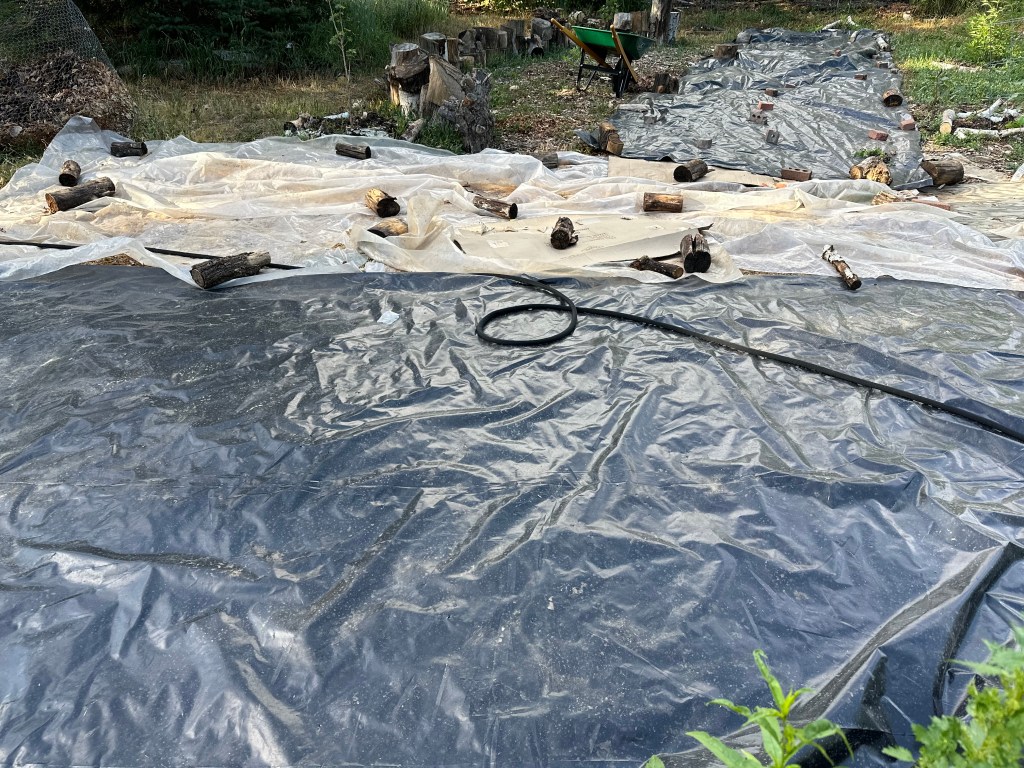
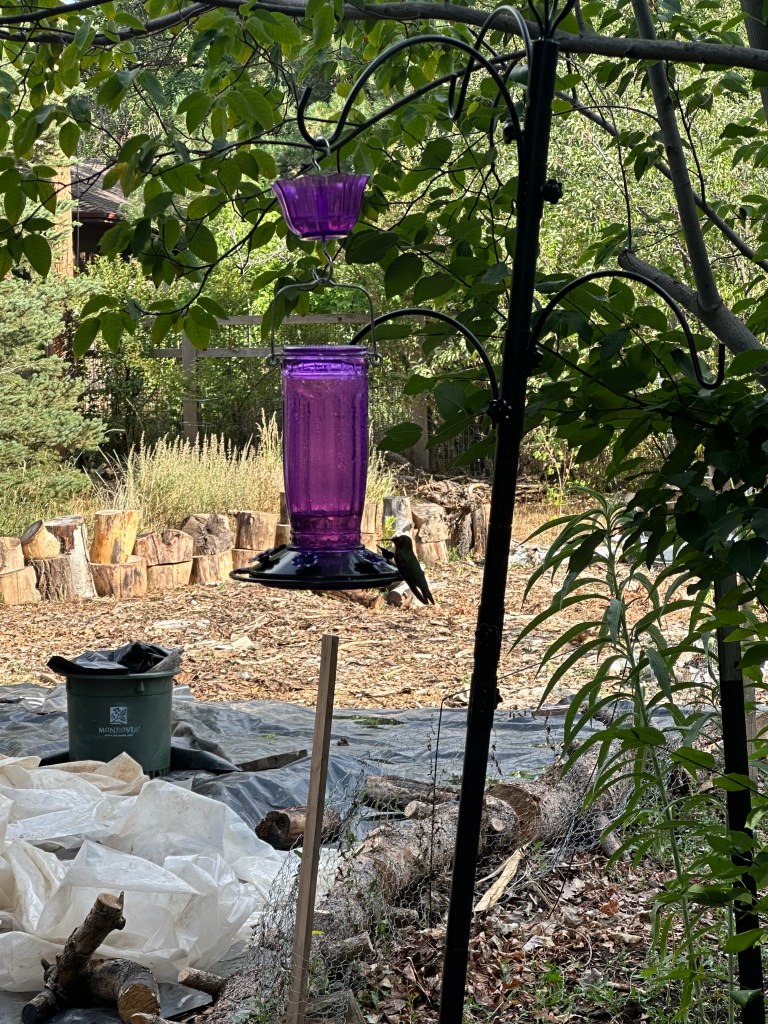
Warning: solarization is unsightly. Imagine an expense of clear or black plastic where there was once lawn. For weeks or months at a minimum. I thought I would be safe doing the ugly in the backyard, but at some point, my neighbor stuck her head over the fence and said her “friend” wondered what the hell we were doing. I explained the project to her. She loves birds, so I was off the hook. If I tried this in a front yard, I’d probably put up a sign explaining it, including a timeline and information about the end product. I can’t imagine solarization being possible if we had an HOA. I also have a bunch of clear plastic that I’m going to try to take to the recycling center (I have no idea if they will accept it now that it’s breaking down and is in chunks) and a bunch of black plastic that will get passed back to my friend for her next project. Otherwise, it’s a lot more trash that you think it is.
Sheet Mulching
Sheet mulching and I have a happy relationship. I used it when I made the front yard 2023 habitat and rain garden (converting our old veggie garden to natives). It was a good choice for the second big area of turf removal to the west of our house (see the other purple polygon on the left of the image above). What this image doesn’t show is our western neighbor’s many large, tall cottonwood trees. In the morning, our house shades the side yard, and in the afternoon, the neighbor trees shade it. Solarization wasn’t an option; we only have a couple of hours of direct sun in that area and we just wouldn’t have the heat from the sun.
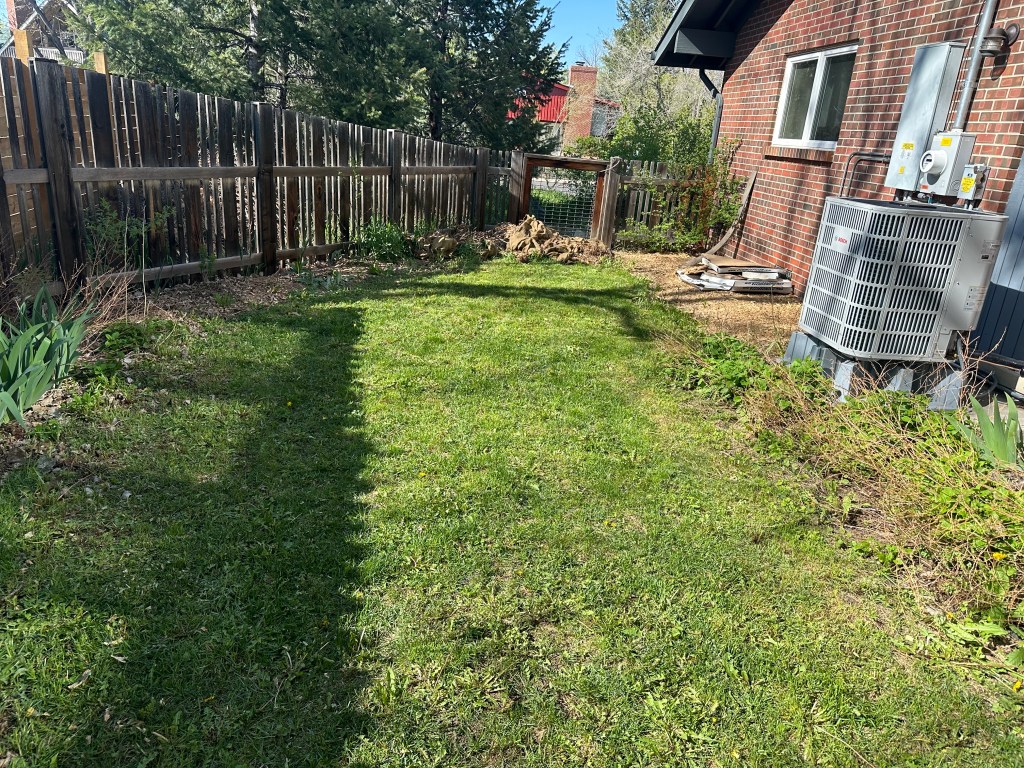
We got cardboard from Craigslist, Nextdoor, and Freecycle. For arborist mulch, we have done Chipdrop and hooked up with local arborists and stump grinders for convenient dumps, and hauled mulch ourselves from the city mulch pile. The supplies are essentially free, but it can involve a little more labor and searching than solarization.
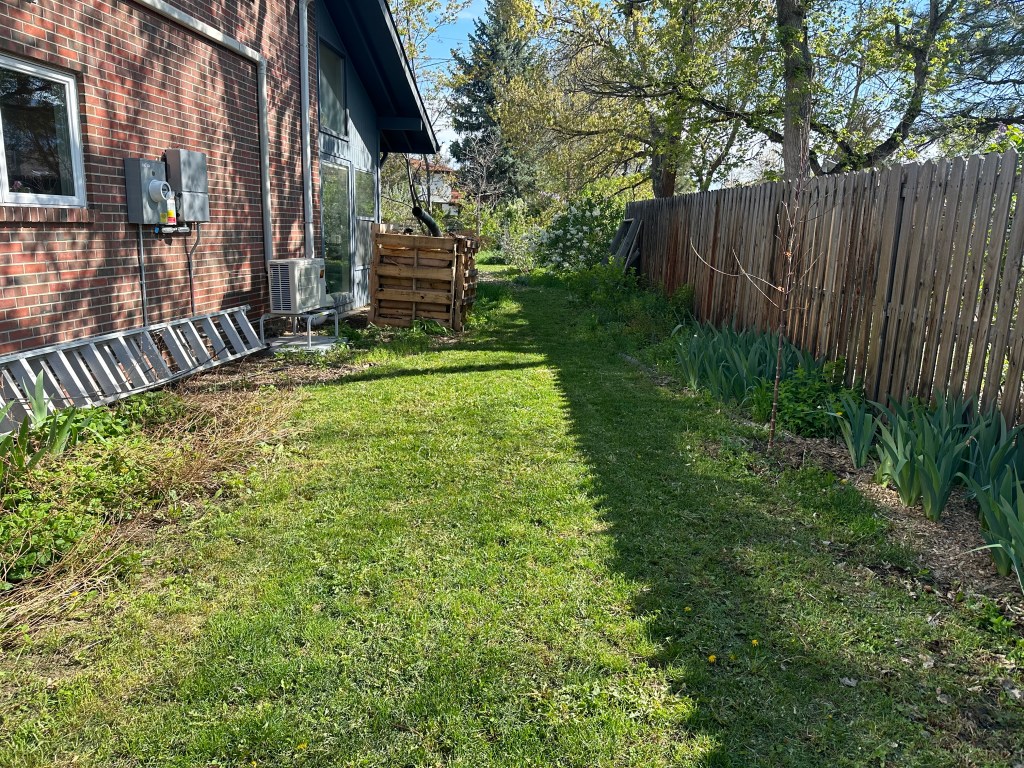
A tradeoff for doing sheet mulching is time. Ideally, you lay down cardboard and arborist mulch, and then you wait at least a few months, but possible a few seasons. If you don’t wait long enough for the grass to be smothered and dead, grass will come up your planting holes when you plant new plants. Another issue is getting the depth of the mulch right. If it’s too deep (or too dry or hasn’t had enough time to break down), the level of the soil will be a few inches below your new surface. (It’s important to break through the cardboard and plant in actual soil, and not in the mulch on top of the cardboard.) Sheet mulching definitely looks much more attractive and tidy for public areas than solarization does; people seem to tolerate plant-free mulch more readily than they do yards of plastic sheeting.
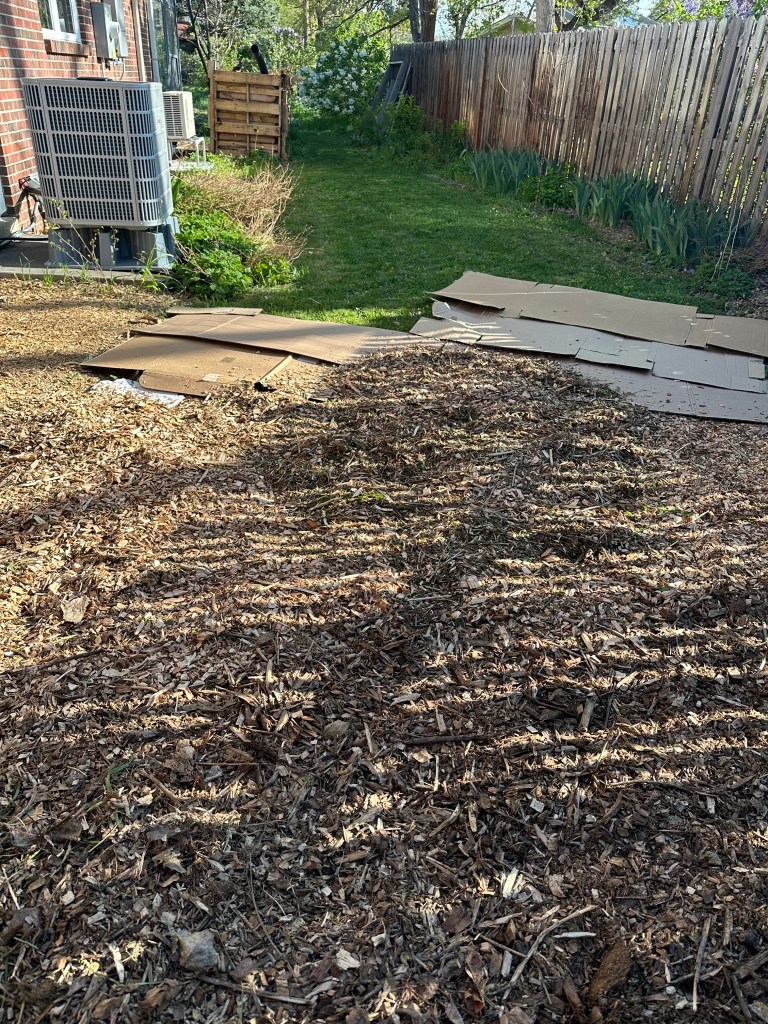
I was working on a tight-ish timeline, and so I mulched as soon as I could gather materials (late April? early May?), and I planted this area midsummer. In terms of temperature, I think we were okay. I had to break the project into phases in order to landscape so much area with relatively little help, so I needed to get to planting. (Meanwhile, we were frying grass in the hot sunny part of the yard under plastic.) It made much more sense to plant in this relatively cooler area of the yard first; the side yard was able to hold onto moisture better, even pre-mulching. We couldn’t plant through plastic, but we could plant through mulch. I do have a bit of grass coming up in some planting holes, but in general, it was an excellent choice and worked well with our timeline. We intend to put a pathway of freecycled materials and a native grass and sedge bioswale down the side yard in the future. We know from the 2013 flood that this is where floodwaters will flow out of our yard. The cardboard and mulch are a good placeholder for both, as it’s clean for walking, and it is easily removed for swale construction.
“Stress the Lawn, Plant Shrubs”
I mentioned this method in part 1 of turf removal; an El Paso County Extension publication on turf removal explains it. Essentially, you scalp the lawn (mow it super short), stop watering it, and plant shrubs, which you water at the plant (no broadcast watering to revive the grass). The grass will get stressed out and die. I’ve mentioned in the past that I have a smooth brome problem because of a pasture grass mix which contained brome seeds with which I seeded parts of my yard. I chose to put in more shrubs in the front yard at the edge (and over the edge) of the grama grass garden where brome creeps in and there’s more shade. This HOT, DRY year was PERFECT for trying this out. We scalped the brome in May, and the summer was so very beastly. I put in several young native shrubs, with carefully weeded and mulched areas around them. They were hand-watered through the summer. I expect that we will have to do more very close mowing of this area before the shrubs get larger, but I feel like I got a toehold here, and I recommend it. Further, this is in our front yard, and we were able to do this in a way which is not unattractive.
Reflection
This is feedback I will give to the funders and in advice to others pursuing similar projects. In retrospect, I wish I had had a longer timeline for lawn killing and that I had just done sheet mulching for all of it. I had been planning to do some lawn killing this year, but this grant turbocharged my timeline. In my 2023 habitat and rain garden projects, I had the cardboard and mulch down in the front habitat and rain garden (yellow polygon in schematic) for at least nine months (Fall, Winter, Spring). I feel like I had better killing of existing plants and better tilth in the soil below the sheet mulching, because the materials were more broken down compared to planting sooner after sheet mulching this year. I’m not sure what that would mean for the grant: could they allow people to follow a two year timeline, with the first year for turf removal, and the second for planting? I feel that if they want to steer grantees away from quick fixes (Roundup) or expensive solutions (sod cutting), a longer time span would allow solarization to really fry turf or for sheet mulching to more fully break down.
 Climate Resilient Landscapes
Leave a comment